
You are three days into a backcountry trek, your phone is dead, and your power bank is blinking its last bar. That is exactly the moment a reliable solar panel earns its place in your pack. The best portable solar panels for hiking balance weight, durability, and real-world charging speed without turning your backpack into a burden.
This guide covers six foldable panels built for trail life, from pocket-sized phone chargers to high-output models that refill a power station. Whether you hike weekends or thru-hike for months, you will find an option that fits your gear list. For a deeper look at ultralight setups, see our guide to the best portable solar panel for backpacking.


How to Choose a Hiking Solar Panel
Hiking panels live a harder life than rooftop arrays. They get folded, stuffed, dropped, and rained on. The four criteria below separate gear that survives the trail from gear that quits at the first cloud.
Weight and Packed Size
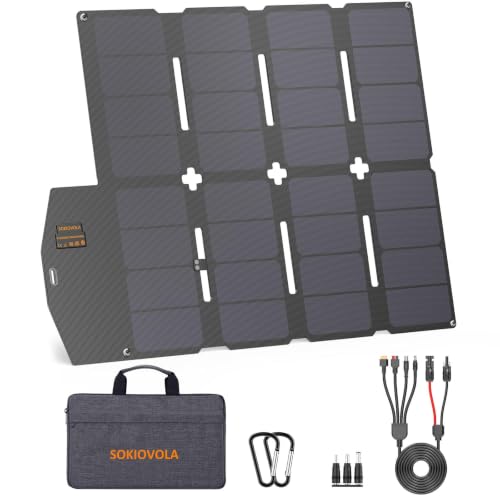
Every ounce counts on a long hike. Sub-3 lb panels like the SOKIOVOLA 50W and GEYOTO 45W disappear into a daypack, while 200W and 400W models demand serious cargo space. Match wattage to your actual devices, not to wishful thinking.
Folded dimensions matter as much as weight. A panel that folds to iPad size slides into a laptop sleeve, while a 31 lb foldable unit belongs on a basecamp table, not in your summit pack.
Output Ports and Device Compatibility
USB-A and USB-C ports handle phones, tablets, and power banks directly. If you carry a portable power station, look for DC, XT60, Anderson, or DC7909 outputs. The 100W Ecosonique panel covers nearly every connector type, which spares you from hunting adapters on the trail.
Check the PD wattage on USB-C. A 25W PD port charges a modern phone quickly, while a 15W port is fine for overnight top-ups. Our roundup of the best portable solar panel brands compares connector standards across major makers.
Cell Efficiency and Real-World Yield
Monocrystalline cells now reach 23% to 26% efficiency, and that number matters when sunlight is scarce. The GEYOTO 45W and SOKIOVOLA 50W both hit roughly 25%, converting more of a weak morning sun into usable charge.
Remember that rated wattage assumes direct, perpendicular sun. Kickstands and adjustable angles recover a meaningful share of lost output, so favor panels with sturdy stands over flat-lay designs.
Weather Resistance and Durability
Trail weather shifts fast. ETFE-laminated panels with IP67 or IP68 ratings shrug off rain and dust, while the junction box on most models stays vulnerable. Keep the control box dry even when the panel itself is soaked.
Integrated laminating technology and UV-resistant EVA layers extend panel life. If you want to stretch your budget without sacrificing durability, our picks for the best portable solar panel for the money highlight value standouts.
Final Thoughts
For most hikers, the sweet spot sits between a pocketable phone charger and a mid-size foldable that can refill a power bank. The GEYOTO 45W Solar Panel Charger Fast Charging wins for ultralight day hikes with its iPad-sized frame and IP68 shell, while the Renogy 200W Portable Solar Panel for Power suits basecamps and longer off-grid trips where output matters more than grams. Pick the one that matches your pack, and the sun will do the rest.
Frequently Asked Questions
How many watts do I need for hiking?
For a phone and power bank, 30W to 50W is plenty. If you carry a tablet, camera, or small power station, aim for 100W or more. Match wattage to your daily energy use rather than buying the biggest panel you can find.
Can a portable solar panel charge directly in cloudy weather?
Yes, but output drops sharply under cloud cover. High-efficiency monocrystalline panels handle diffuse light better than older polycrystalline designs. Expect slower charging and plan to pair the panel with a power bank for buffer capacity.
Are hiking solar panels waterproof?
Many panels carry IP67 or IP68 ratings on the laminated surface, which handles rain and splashes. The junction box and ports usually are not waterproof, so keep them covered. For more high-output options, browse our best portable solar panel 400W roundup.
How do I get the most power from a solar panel on the trail?
Angle the panel perpendicular to the sun and reposition it every hour or two. Use the kickstand or hang it from your pack with carabiners. Avoid shading from trees or your own body, since even partial shade can cut output dramatically in 2026’s high-efficiency cells.
Ready to compare more options?
Explore our full portable solar panels category for buying guides and top picks.