
You’re planning a weekend camping trip, and you realize your phone, camera, and portable power station all need charging. You could rely on a wall outlet, but you’re miles from the nearest one. That’s where a reliable portable solar panel comes in. In this guide, we’ll explore the best portable solar panel brands of 2026, covering key features, compatibility, and what to look for to make an informed choice.
Whether you’re a seasoned RVer, a backpacker, or just need a backup for emergencies, we’ve got you covered. We’ve analyzed top models from SOKIOVOLA, Renogy, MARBERO, and more to bring you a curated list of the finest portable solar panels on the market.



Buying Guide: What to Consider in a Portable Solar Panel
Choosing the right portable solar panel involves more than just picking the highest wattage. You need to consider efficiency, portability, durability, and compatibility with your existing gear. Let’s break down the key factors.
Power Output and Efficiency
The wattage of a solar panel determines how much power it can generate under ideal sunlight. Higher wattage panels, like 200W or 400W, are great for charging power stations quickly, but they’re also heavier and larger. Efficiency, measured as a percentage, indicates how well the panel converts sunlight into electricity. Look for panels with at least 22% efficiency for better performance in limited sunlight.
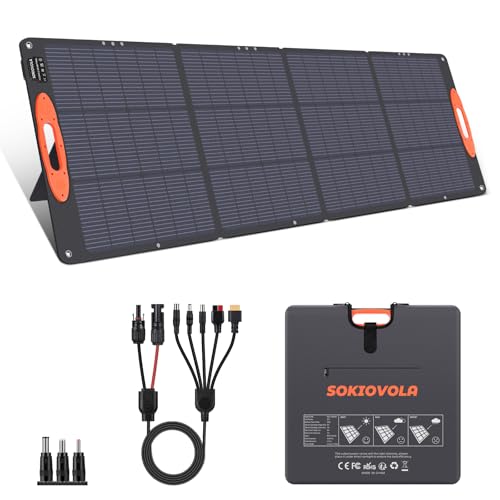
For instance, the SOKIOVOLA N-Type 16BB 200W Portable Solar Panel boasts up to 25% efficiency, which is excellent for cloudy days. If you’re backpacking, a smaller 30W panel might suffice, but expect longer charging times.
Portability and Weight
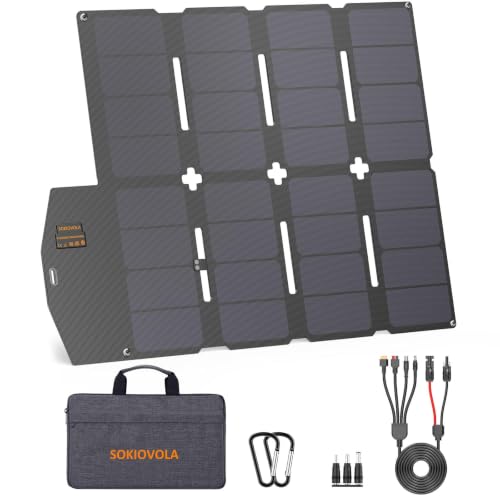
Portability is crucial, especially if you’re hiking or backpacking. Foldable panels that collapse into a compact size and weigh under 5 pounds are ideal for carrying in a backpack. The SOKIOVOLA 100W Portable Solar Panel MC-4 Foldable weighs just 4.6 lbs and folds to a small footprint, making it a great travel companion.
For car camping or RV trips, you might prioritize higher wattage over weight. Panels like the Renogy 200W are heavier but provide more power. Consider your primary use case to balance portability and performance.
Durability and Weather Resistance
Outdoor conditions can be harsh, so your solar panel needs to withstand rain, dust, and extreme temperatures. Look for panels with IP65 or IP68 ratings, indicating water and dust resistance. ETFE lamination is a premium feature that enhances durability and light transmission, as seen in the SOKIOVOLA and CTOLITY models.
High-quality materials like Oxford cloth and PET lamination also add to longevity. When you’re investing in a portable solar panel, you want it to last for many trips, so don’t skimp on build quality.
Compatibility with Power Stations and Devices
Before buying, check the output ports and connectors. Most panels come with MC4 connectors and various adapters (XT60, Anderson, DC5521) to work with popular power stations like Jackery, EcoFlow, and Bluetti. Some panels also have USB-A and USB-C ports for directly charging phones and laptops.
The 100W Portable Solar Panel with USB-C/A & 20V DC from Ecosonique Technology includes a wide array of adapters, making it nearly universal. Always verify your power station’s input voltage and connector type to ensure compatibility.
Final Thoughts
In the world of portable solar panels, the best portable solar panel brands offer a blend of efficiency, durability, and portability. For a lightweight and versatile option, the SOKIOVOLA 100W Portable Solar Panel MC-4 Foldable is an excellent choice, ideal for backpackers and campers. If you need more power for RV trips or off-grid living, the Renogy 200W Portable Solar Panel stands out with its high efficiency and robust build. Whichever you choose, you’re investing in reliable, renewable energy for your adventures.
Frequently Asked Questions
How long does it take to charge a power station with a portable solar panel?
Charging time varies based on panel wattage, sunlight intensity, and power station capacity. A 100W panel can charge a 300Wh power station in about 3-5 hours of direct sunlight. Higher wattage panels like 200W or 400W will significantly reduce this time.
Can I use a portable solar panel on cloudy days?
Yes, but the output will be lower. Panels with high efficiency (above 22%) perform better in low-light conditions. For example, the MARBERO 30W panel still generates 15-20W on cloudy days, which is enough for small devices.
What is the difference between MC4 and XT60 connectors?
MC4 connectors are standard for solar panels, while XT60 is common for portable power stations. Many panels include adapter cables to convert MC4 to XT60, Anderson, or DC5521, ensuring compatibility with various brands like Jackery and EcoFlow.
Are portable solar panels waterproof?
Most portable solar panels have an IP65 or IP68 rating, meaning they are resistant to water splashes and dust. However, it’s best to keep connectors dry and avoid submerging the panel. For more tips, check out our guide on solar panel kits for camping.