

Picture this: you are camping under the stars, and your phone battery dies, or a storm knocks out power at home, leaving your fridge and lights useless. A portable power station solves these problems by providing reliable, quiet, and emission-free electricity wherever you need it. In this guide, we review eight of the best portable power stations of 2026, covering compact models for weekend trips and larger units for home backup. Whether you are a weekend camper, an RV enthusiast, or preparing for emergencies, we have you covered.





Buying Guide
Capacity and Power Output
The capacity (measured in watt-hours, Wh) determines how long your devices will run. A 256Wh unit like the ALLWEI 300W is great for charging phones, laptops, and a CPAP machine for a night. For larger appliances like a mini fridge or electric kettle, consider 1000Wh or more, such as the Jackery Explorer 1000 v2 or BLUETTI Elite 100 V2. The continuous wattage (W) and surge power matter too: 300W to 600W handles small electronics, while 1500W to 1800W can run a refrigerator or microwave. Always check the starting surge of your devices.
Battery Chemistry and Lifespan
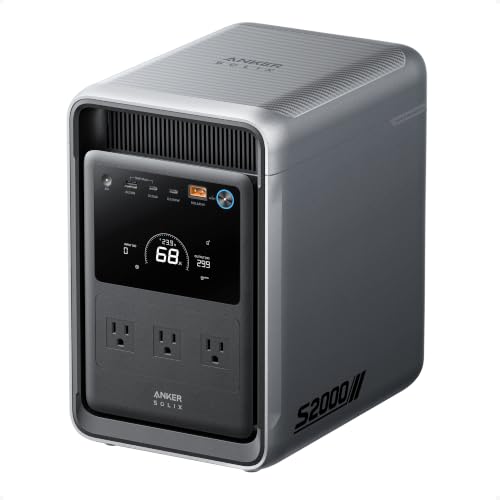
Most modern portable power stations use LiFePO4 (LFP) batteries, which last 3,000 to 10,000 charge cycles, roughly 10 years or more. This chemistry is safer, more stable, and performs better in extreme temperatures than older lithium-ion cells. Models like the Anker SOLIX S2000 boast 10,000 cycles, while the Jackery Explorer 300 offers 4,000 cycles. For long-term investment, LFP is the clear winner.
If you need more details on battery types, check our power stations guide for a deeper dive into technology.
Charging Speed and Options
Fast charging is a game-changer. The EF ECOFLOW Delta 3 charges fully in 56 minutes via AC, while the BLUETTI Elite 30 V2 reaches 80% in 45 minutes. Solar input is crucial for off-grid use: look for MPPT controllers and high wattage support. Many units also support car charging and dual input (AC + solar) for faster top-ups. A station that charges quickly gives you more flexibility during outages or trips.
Portability and Build Quality
Weight and size matter if you plan to carry the station. The DaranEner 192Wh weighs only 5.73 lbs, while the Anker SOLIX S2000 at 35.7 lbs is best for stationary use. Look for ergonomic handles, compact designs, and durable casings. Some models like the BLUETTI Elite 100 V2 are 35% smaller than competitors, making them easy to stash in a car trunk or RV. For more tips on choosing the right size, visit our portable power stations category.
Final Thoughts
After reviewing these models, our top recommendations cater to different needs: for lightweight camping and daily carry, the ALLWEI Portable Power Station 300W offers a great balance of capacity and portability at a reasonable price, while for serious home backup and extended off-grid use, the Anker SOLIX S2000 Portable Power Station, 2,010Wh delivers massive capacity and a long lifespan. Both are excellent choices depending on your priorities.
Frequently Asked Questions
How long does a portable power station last? Most modern LiFePO4 stations last 3,000 to 10,000 charge cycles, which translates to 10 to 15 years of regular use. The Anker SOLIX S2000, for example, offers up to 10,000 cycles.
Can a portable power station run a refrigerator? Yes, but you need at least 1000Wh capacity and 1500W continuous output. Models like the Jackery Explorer 1000 v2 or BLUETTI Elite 100 V2 can power a mini fridge for several hours. Always check the fridge’s starting wattage.
What is the best portable power station for camping in 2026? For most campers, the BLUETTI Elite 30 V2 (288Wh) or ALLWEI 300W (256Wh) are excellent for charging phones, laptops, and lights. If you need more power for a CPAP or small fridge, the Jackery Explorer 300 is a solid choice.
How do I charge a portable power station with solar panels? Connect the station to a compatible solar panel using the MC4 or Anderson connector. Make sure the panel’s voltage matches the station’s input range. Most units have built-in MPPT controllers for efficient charging. For more details, see our power stations guide.
